The Toridoll Group has adopted a policy of accelerating business expansion while maintaining soundness and transparency by demonstrating agility through rapid decision-making, and has developed management organizational structures and mechanisms accordingly. In addition, an Audit and Supervisory Committee has been established as an auditing and supervisory body for management, and each member attends Board of Directors meetings and, when management decisions are made, provides opinions, necessary advice, and exercises voting rights from the perspective of ensuring sound management. At meetings of the Audit and Supervisory Committee, which are held concurrently, information is shared among members, and efforts are made to promptly disclose information in order to aim for highly transparent management.
Toridoll Holdings is strengthening its governance system to enhance corporate value in the medium to long term. The Board of Directors consists of six members (as of July 2026), three internal directors and three external directors, ensuring a system that allows for agile decision-making while maintaining soundness and transparency. In addition, to appropriately supervise business execution, the company has appointed three independent external directors (all women) and three independent external directors with legal qualifications or management experience at other companies as audit and supervisory committee members, thereby strengthening its audit system.
Policy and Management System
Corporate Governance Systems
Toridoll Holdings is strengthening its governance system to enhance its corporate value in the medium to long term. The Board of Directors consists of six members (as of July 2026), three internal directors and three external directors, ensuring a system that allows for agile decision-making while maintaining soundness and transparency. In addition, to appropriately supervise business execution, the company has appointed three independent external directors (all women) and three independent external directors with legal qualifications or management experience at other companies as audit and supervisory committee members, thereby strengthening its audit system.
Management System

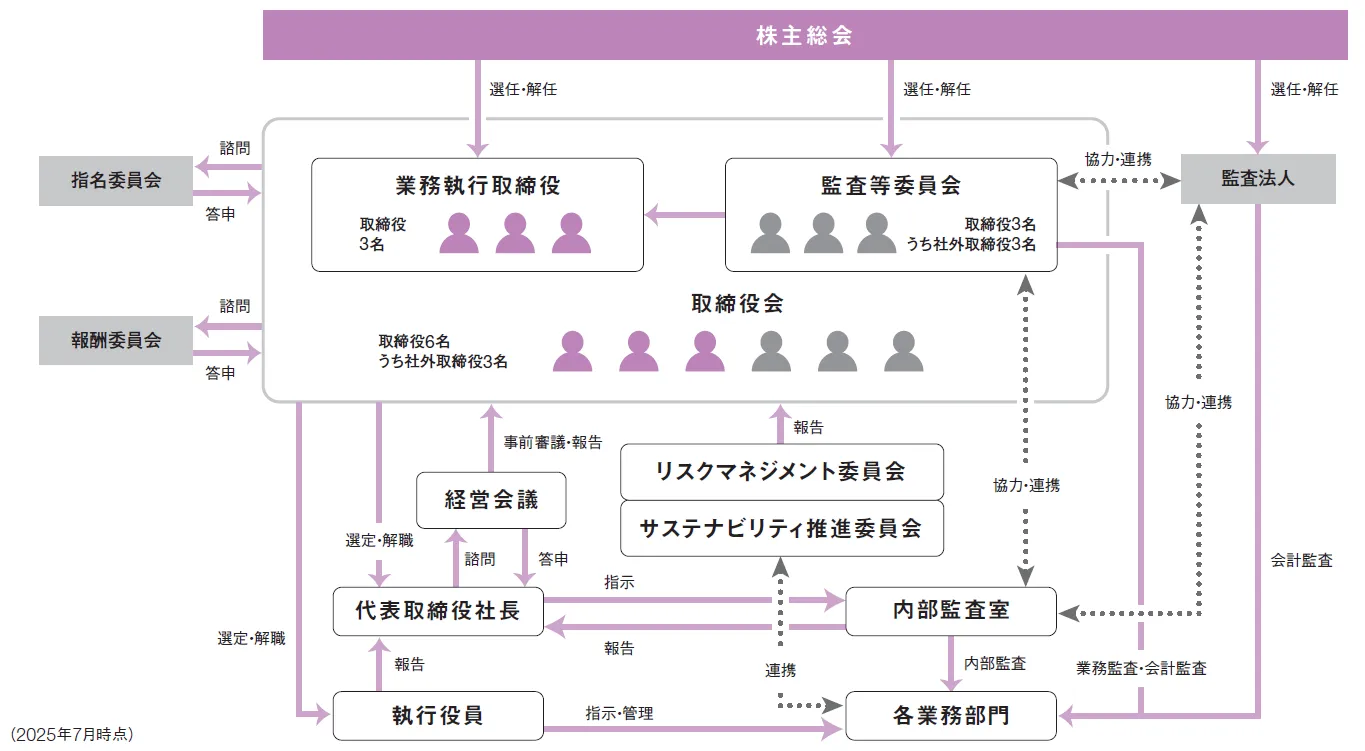
Roles of the Board of Directors and other major meetings, and status of holding and attending
The roles of the Board of Directors and key meetings, and their status in the fiscal year ending March 2026, are as follows:
role | Number of events | |
board of directors | This is a council composed of directors who have been entrusted with managing the company by the shareholders, and it makes decisions on important company matters in accordance with laws, regulations, and the articles of incorporation. | 16 |
Audit and Supervisory Committee | This is a meeting body composed of audit and supervisory committee members who have been entrusted by shareholders with the task of auditing and supervising company management, and it audits and supervises the performance of duties by directors. | 16 |
Nomination Committee | This committee, primarily composed of outside directors, deliberates on the appointment and dismissal of directors (including audit and supervisory committee members) and executive officers, and submits its recommendations to the Board of Directors and the Audit and Supervisory Committee. | 6 |
Compensation Committee | This committee, which is primarily composed of outside directors, deliberates on remuneration for directors (including audit and supervisory committee members) and executive officers and reports to the Board of Directors and the Audit and Supervisory Committee. | 6 |
Risk Management Committee | This committee, established under the Board of Directors, discusses and approves issues and countermeasures related to the promotion of company-wide risk management. | 4 |
Sustainability Promotion Committee | This committee, established under the Board of Directors, discusses and approves issues and countermeasures related to the promotion of sustainability across the company. | 4 |
Attendance at Board of Directors and Audit Committee meetings (Fiscal year ending March 2026)
Title | Name | Board of Directors | Audits, etc. Committee | name Committee | Rewards Committee |
President and CEO chief executive officer | Takaya Awata | ◎ (16 times/16 times) | ● (6 innings/6 innings) | ● (6 innings/6 innings) | |
|---|---|---|---|---|---|
Director and CFO CFO | Satoshi Yamaguchi | ● (16 times/16 times) | |||
Director and CHHO Chief Happiness Human Officer | Kenichi Tanaka | ● (16 times/16 times) | |||
Outside Director Audit and Supervisory Committee Members | Rieko Matsukaze | ● (16 times/16 times) | ◎ (11 times/11 times) | ● (6 innings/6 innings) | ● (6 innings/6 innings) |
Outside Director Audit and Supervisory Committee Members | Maki Kataoka | ● (16 times/16 times) | ● (16 times/16 times) | ● (6 innings/6 innings) | ● (6 innings/6 innings) |
Director (outside) Audit and Supervisory Committee Member | Yuko Miyata | ● (11 times/11 times) | ● (11 times/11 times) | ● (6 innings/6 innings) | ● (6 innings/6 innings) |
*◎… Indicates the chairperson or committee chairman for the term ending March 2026.
*The number of times Rieko Matsukaze has attended Audit and Supervisory Committee meetings is based on those held since her appointment as a director serving on the Audit and Supervisory Committee on June 27, 2025.
*The attendance count for Yuko Miyata covers board meetings and committee meetings held since her appointment as a director and audit committee member on June 27, 2025.
Assessment of the Effectiveness of the Board of Directors
Starting in fiscal year 2024, we invited a third-party organization (Board Advisors Co., Ltd.) to participate in board meetings, various committee meetings, and other preparatory activities for evaluating the effectiveness of our board of directors. Through these activities, we have been continuously working to improve the board's initiatives and other aspects, taking into account objective advice from a third party.
In fiscal year 2025, the organization conducted a third-party evaluation of the effectiveness of the Board of Directors, including a pre-evaluation questionnaire and individual interviews with all directors. As a result, it was confirmed that the effectiveness of our Board of Directors is at a certain level, thanks to the efforts made to reform the Board of Directors, in which executives and outside directors share a common understanding of the major direction and challenges the Board aims to achieve in order to sustainably improve corporate value.
On the other hand, our Board of Directors is required to exercise its supervisory function in a way that is appropriate for the new stage of growth. From the perspective of further improving effectiveness, and especially given the current transitional period, there has been some discrepancy in understanding among the directors regarding the role that the Board of Directors should play, and the need for consensus building has been observed.
In order to further improve the effectiveness of our Board of Directors, it is necessary to consider the following issues, and we will continue to work on these issues going forward.
- Consensus on the role of the board of directors
- Further improvement of the quality of board discussions
- Advanced board of directors operations
- Strengthening internal controls
- Ensuring the effectiveness of committee functions
- Deepening mutual understanding between the director and the executive team.
Internal Control Systems
TORIDOLL Holdings has formulated clear fundamental policies that the President and CEO must comply with, enacted various provisions necessary for the establishment of internal control systems, and positioned them for implementation as quickly as possible under the guidance of the person-in-charge. We continually review and improve internal control systems and seek to create efficient and lawful corporate structures.
Internal Audit Systems
Toridoll Holdings has established the "Internal Audit Regulations" and established an Internal Audit Office as an organization reporting directly to the President and CEO. The Internal Audit Office formulates audit policies and annual plans, audits the status of business execution based on the prescribed rules for each department at the head office and group companies, evaluates the status of internal control and its operation, and proposes improvements. The results of the audits are reported to the President and CEO and the Audit and Supervisory Committee (outside directors).
Accounting Audits
Toridoll Holdings has an audit agreement with KPMG AZSA LLC, ensuring that accounting audits are conducted independently and fairly. Furthermore, Toridoll Holdings' Audit and Supervisory Committee and Internal Audit Office conduct audits in cooperation with KPMG AZSA LLC through regular reporting meetings.
Strategic Shareholdings
TORIDOLL Group does not hold listed shares as strategic shareholdings. The Group policy is to not engage in such holdings in order to avoid the risks of fluctuations in share prices and to enhance capital efficiency.
Election of Directors and Officer Compensation
Appointment of Directors
Toridoll Holdings has established a voluntary nomination committee of which all independent outside directors make up a majority of the members, and it is its policy to receive recommendations from the nomination committee when nominating candidates for directors (including directors who are audit and supervisory committee members).
The Nomination Committee deliberates whether each candidate meets the selection criteria established by the Board of Directors, and then decides on the content of its recommendations to ensure that the board of directors is composed of a good balance of the knowledge, experience, and abilities required to effectively fulfill the roles and responsibilities of a director, and that the board is composed of both diversity and an appropriate size.
Skills Matrix for the Board of Directors and Executive Officers
Our executive directors are highly experienced individuals with expertise in the restaurant industry, food distribution, and overseas operations. Among our independent outside directors, those serving as audit and supervisory committee members are selected based on their management experience in other companies, their knowledge of accounting and finance, their legal expertise, and their expertise in compliance and human resources. Furthermore, considering gender diversity, we have appointed three female directors. The specific expertise and experience of our directors and executive officers are detailed in the table below.
Business Management | global | Accounting and Finance | Capital Policy M&A | Legal, Compliance, and Risk Management | ESG | Food and beverage business | marketing· Store Development | product quality management | DX Innovation | Digital Technology ICT | Personnel, Labor and Human Resources Development | |
|---|---|---|---|---|---|---|---|---|---|---|---|---|
Takaya Awata | ● | ● | ● | ● | ||||||||
Satoshi Yamaguchi | ● | ● | ● | ● | ||||||||
Kenichi Tanaka | ● | ● | ● | ● | ||||||||
Rieko Matsukaze | ● | ● | ● | ● | ● | ● | ● | |||||
Maki Kataoka | ● | ● | ● | |||||||||
Yuko Miyata | ● | ● | ● | ● | ● | |||||||
Atsushi Kusano | ● | ● | ● | ● | ||||||||
Hiroshi Yamaguchi | ● | ● | ● | ● | ||||||||
Kohei Oshita | ● | ● | ● | ● | ||||||||
Toru Hatomoto | ● | ● | ● | ● | ||||||||
Kazuki Onda | ● | ● | ● |
Independent External Directors
TORIDOLL Holdings made the transition to a company with an Audit and Supervisory Committee in order to reinforce its corporate governance systems and elected three independent external directors with the qualities necessary for their expected roles and responsibilities.
The Company elects independent external directors to half (three) of the seats on the six-member Board of Directors in order to appropriately reflect opinions that are independent from management when making various decisions on investment and other matters for the future growth of business.
Audit and Supervisory Committee Member | Independent Director | Supplementary explanation regarding compliance items | Reasons for selection | |
Rieko Matsukaze | ○ | ○ | We have designated him as an independent director. | He possesses extensive experience, achievements, and knowledge in global business management, marketing, and accounting/finance. We have appointed him as an outside director because we believe he is suitable for the role, as he can provide accurate suggestions and advice on our management from an objective and professional perspective. We have designated him as an independent director because we determined that he has no conflict of interest with our company, can supervise from an independent standpoint, and there is no risk of a conflict of interest with general shareholders. |
Maki Kataoka | ○ | ○ | We have designated him as an independent director. | We have appointed him as an outside director because we believe he is suitable for the role, as he can provide accurate opinions based on his professional knowledge as a lawyer. We have determined that he has no conflict of interest with the Company, is able to oversee the Company from an independent standpoint, and is not likely to pose a conflict of interest with general shareholders, and therefore designated him as an independent director. |
Yuko Miyata | ○ | ○ | We have designated him as an independent director. | He has extensive experience in overseas assignments in the United States and the United Kingdom, as well as in business decision-making, governance, compliance, and especially in human resources. We have appointed him as an outside director because we believe he will be able to leverage his expertise to audit, supervise, and advise our management. We have determined that he has no conflict of interest with the Company, is able to oversee the Company from an independent standpoint, and is not likely to pose a conflict of interest with general shareholders, and therefore designated him as an independent director. |
Policy on Determination of Officer Compensation
Based on our executive compensation regulations, we have introduced a compensation system that increases the proportion of compensation linked to medium- to long-term performance and the proportion of company stock compensation, thereby providing directors (excluding audit and supervisory committee members) with an incentive to continuously improve the corporate value of our group, and to promote the early sharing of value with shareholders.
1. Basic principles of executive compensation systems
The compensation for directors (excluding audit and supervisory committee members) consists of base salary, short-term incentive compensation (performance-linked bonuses), and long-term incentive compensation (restricted stock and stock options).
The compensation for directors (and audit and supervisory committee members) consists of a base salary and long-term incentive compensation (stock options).
2. Remuneration Determination Procedure
When determining the compensation of our directors (excluding audit and supervisory committee members), we ensure objectivity in the level of compensation for directors (excluding audit and supervisory committee members) by obtaining advice from external expert organizations based on executive compensation survey data (including the percentage of each type of compensation).
Furthermore, the compensation of directors (excluding audit and supervisory committee members), including the percentage of each type of compensation, is determined after reviewing the recommendations of the Compensation Committee, of which all independent outside directors are members and which constitutes a majority of the committee members.
3. Overview of Short-Term Incentive Compensation (Performance-Linked Bonuses)
The total amount of performance-linked compensation for directors (excluding audit and supervisory committee members) is capped at the total amount payable for the relevant fiscal year, as predetermined by the Board of Directors. As shown in Figure 4, financial indicators include the degree to which the Group has achieved its targets for consolidated sales revenue and consolidated operating profit for the relevant fiscal year. Non-financial indicators include employee engagement, ESG (environmental, social, and governance) related status, and the degree to which the performance of the assigned department has been achieved. The compensation is determined based on an evaluation ratio set for each indicator.
These evaluation indicators have been selected to motivate our group to expand corporate value, improve profitability, enhance employee engagement, and address challenges related to sustainability.
Total amount of compensation for directors and audit committee members (for the fiscal year ending March 2026)
classification | Total amount of remuneration (million yen) | Total amount by type of remuneration (million yen) | Number of applicable executives (persons) | ||
|---|---|---|---|---|---|
Base compensation | Performance-linked remuneration | Non-monetary remuneration, etc. | |||
Directors (exc. Audit and Supervisory Committee members) (including outside directors) | 124 (3) | 110 (3) | ー (ー) | 14 (ー) | 5 (1) |
Director (Audit and Supervisory Committee Member) (including outside directors) | 31 (31) | 31 (31) | ー (ー) | ー (ー) | 5 (5) |
Total (including outside directors) | 156 (34) | 142 (34) | ー (ー) | 14 (ー) | 10 (6) |






.png)




.png)